Operationalize MLOps Fast: Platform Agnostic Steps for Tech Leaders

The core of reliable MLOps comes down to five habits: version everything, automate CI/CD and continuous training, test data and models with the same rigor as code, monitor for drift with clear retraining triggers, and enforce governance from day one. Google's Practitioners guide to MLOps and the AWS MLOps checklist both point to the same conclusion. Below, Yslootahtech breaks each habit into steps you can actually run this quarter.
TL;DR:
- Version training data, models, and feature definitions separately to enable quick identification of the root cause of performance changes.
- Implement continuous validation checks at ingestion, including schema validation, null and distribution drift tests, and snapshotting before training.
- Promote code through environments instead of model files alone, ensuring reproducibility and traceability in the deployment pipeline.
- Use automated drift detection and business KPIs to trigger retraining and rely on canary or shadow deployments for safe model updates.
- Establish clear governance processes with documentation, human sign-offs, explainability artifacts, and audit logs to meet regulatory and internal compliance standards.
Table of Contents
- What Are the Foundations of MLOps Best Practices?
- How Do You Build Reliable Data Pipelines and Feature Stores?
- What Should You Version and Track in a Model Registry?
- How Do CI/CD and Continuous Training Actually Work in MLOps?
- What Testing and Validation Does Every ML Pipeline Need?
- How Do You Monitor Models and Know When to Retrain?
- What Infrastructure and Deployment Patterns Support Scalable MLOps?
- How Do You Build Governance and Auditability Into MLOps?
- What Security and Compliance Controls Belong in MLOps?
- What Does a First MLOps Sprint Look Like in Practice?
- Build vs. Buy: Strategic Trade-offs for MLOps Platforms
- Ready to Operationalize Your ML Systems?
- Sources
- FAQ
What Are the Foundations of MLOps Best Practices?
MLOps is not a deployment event. It is a continuous methodology that unifies ML development and operations into one repeatable system, with standardized processes covering experimentation, model registries, and monitoring, according to the Practitioners Guide to MLOps. Treat it as a discipline you practice weekly, not a project you finish once.
Most teams fail by trying to build everything at once, chasing a fully automated pipeline before they've even versioned their training data. A better approach: crawl, walk, run. Crawl means getting reproducibility right. Walk means adding automation around the pieces that break the most. Run means full continuous training with automated promotion gates.
That sequencing matters because premature automation locks in bad assumptions. If your feature definitions are inconsistent, automating retraining just means you retrain faster on broken data.
Here's a readiness checklist worth running in week one, adapted from the AWS MLOps checklist:
- Confirm every dataset used for training has a version identifier and a snapshot you can reload.
- Set up experiment tracking (MLflow or an equivalent) before the next training run, not after.
- Identify one model already in production and document its current lineage from raw data to prediction.
- Write down who owns retraining decisions today, even if the answer is "nobody, informally."
- Pick one metric that would tell you the model is degrading, and check whether you're currently capturing it.
None of these require new infrastructure. They require someone to sit down for an afternoon and answer honestly where the gaps are. Teams that skip this step tend to discover, six months into an MLOps initiative, that they've automated a pipeline built on data nobody can reproduce.
How Do You Build Reliable Data Pipelines and Feature Stores?
Data problems, not model problems, cause most production failures in machine learning. The single most common root cause is training-serving skew, where the transformation logic used during training doesn't match what runs at inference time, according to a detailed pipeline breakdown from MLOps Lab. The fix is architectural, not procedural: build stateless preprocessing modules fitted only on training data, then apply that exact same transform path during inference.
That single discipline. Fit on train, apply everywhere. Eliminates an entire category of bugs that otherwise show up as mysterious accuracy drops weeks after launch.
Feature stores extend this idea. An offline store holds historical feature values for training, while an online store serves consistent feature definitions at low latency for real-time predictions. Keeping both stores backed by one canonical definition, rather than two teams maintaining separate feature logic, is what makes a feature store worth the setup cost.
Build these checks into your ingestion pipeline, in roughly this order:
- Schema validation — reject records where column types or required fields don't match the expected contract.
- Null rate checks — flag when missing values in a critical column jump beyond a set threshold.
- Cardinality checks — catch when a categorical feature suddenly gains or loses unique values, often a sign of an upstream change.
- Distribution drift checks — compare incoming feature distributions against a training baseline using a statistical test.
- Snapshot and version the validated batch before it ever reaches a training job.
Run checks one through four at ingestion, before data enters your feature store. Run the snapshot step immediately after validation passes.
Pro Tip: Version your feature transformation code separately from your model code. When a feature definition changes, you want to know immediately whether it was the model or the pipeline that caused a metric shift, and separate versioning gives you that answer in minutes instead of days.
What Should You Version and Track in a Model Registry?
If you can't reproduce a model from eighteen months ago, you don't have MLOps. You have a collection of scripts and good intentions. Versioning is the practice that enables precise identification of exactly what we trained and how to rebuild it.
Five key things benefit from version control, though teams vary in how many they version:
- Code, including training scripts, preprocessing modules, and the pipeline orchestration logic itself.
- Data snapshots, tied to a specific ingestion run rather than a live table that keeps changing underneath you.
- Feature definitions, separate from the data itself, since the same raw column can be transformed multiple ways.
- Model artifacts, including weights, serialized objects, and the exact library versions used to produce them.
- Container images, so the runtime environment is as reproducible as the model file inside it.
For every experiment, capture training parameters, dataset snapshots, evaluation metrics, and environment details. Tools like MLflow's experiment tracking and model registry exist specifically to make this capture automatic instead of a manual spreadsheet exercise, and skipping it is the single fastest way to lose a promising result to a forgotten configuration.
A model registry then governs how a trained model moves toward production. Databricks recommends a staged workflow where models move through evaluation phases with promotion criteria and rollback plans, per Databricks' MLOps workflow guidance. That gate should check accuracy on a held-out set, fairness across key data slices, latency under expected load, and a manual sign-off for anything touching a regulated decision.
How Do CI/CD and Continuous Training Actually Work in MLOps?
The biggest mindset shift in a mature MLOps pipeline is this: you promote code through environments, not model files. A model dropped into production without the pipeline that created it lacks traceability and is difficult to safely retrain. Databricks' own workflow guidance makes this the central recommendation, promote the training pipeline itself from development to staging to production, so the model running in production was built by the exact code sitting in your production branch.
Your CI suite for an ML pipeline needs to check more than the usual software tests. Run these, roughly in this order, on every pull request or scheduled build:
- Unit tests on preprocessing functions and feature transformation logic, isolated from any live data.
- Data tests that validate schema and distribution against the latest snapshot before training starts.
- Model performance tests that compare a freshly trained candidate against the current production baseline on a fixed evaluation set.
- Integration tests that run the full pipeline end to end in a staging environment, not just individual components.
- Container smoke tests confirming the serving image starts, loads the model, and returns a prediction within an expected time window.
- Load tests simulating production-level traffic to catch latency regressions before they hit real users.
Continuous training (CT) extends this further by triggering retraining automatically. Google Cloud's architecture guidance on MLOps describes CT as responding to new data availability, code changes, or measured performance degradation, with automated validation and metadata tracking required to keep every retraining run auditable. The practical approach combines both trigger types: a scheduled retrain on a fixed cadence (weekly, monthly) as a baseline, plus an event-triggered retrain when a monitored drift metric crosses a threshold.
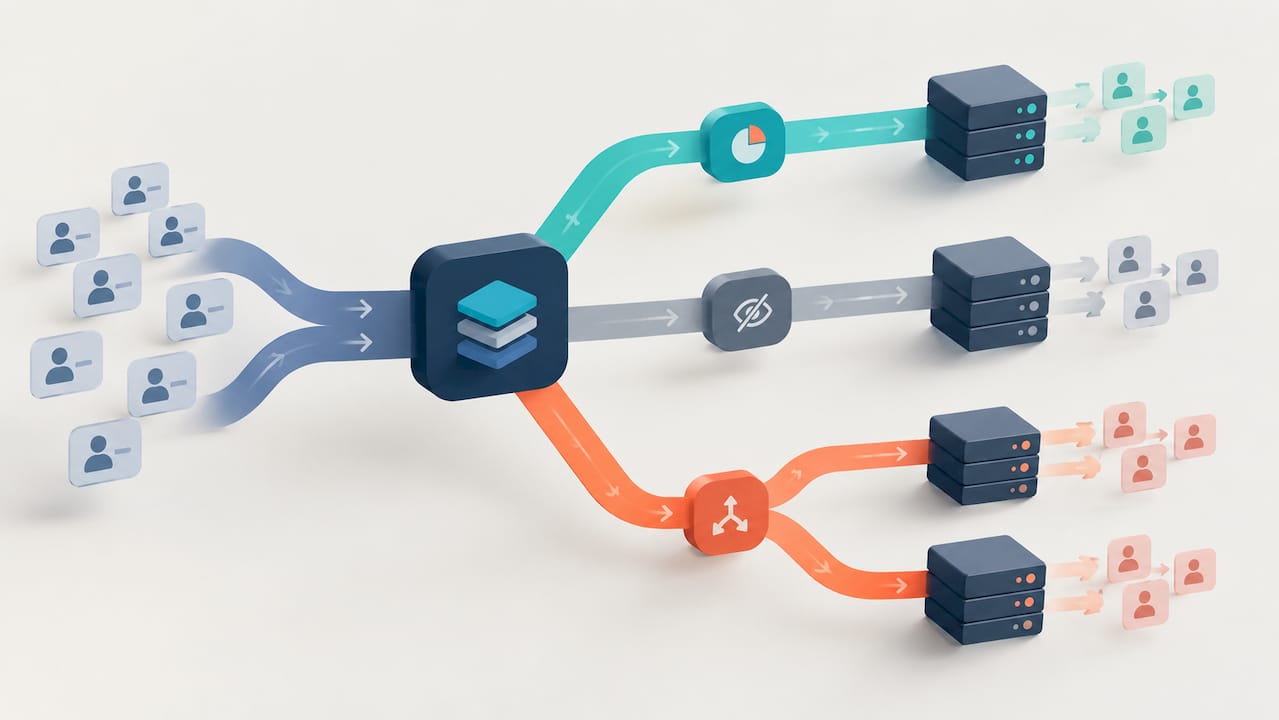
Never push a freshly retrained model straight to 100% of traffic. Use a canary release that sends a small slice of traffic to the new model while watching key metrics, a shadow deployment that runs the new model silently alongside production without affecting real decisions, or an A/B test that splits traffic and measures outcomes statistically.
Pro Tip: Set an explicit rollback time budget before you ever deploy. Decide in advance how long a canary runs and what metric threshold triggers an automatic revert, so that decision isn't made under pressure at 2 a.m. when a dashboard turns red.
What Testing and Validation Does Every ML Pipeline Need?
Software tests check whether code runs correctly. ML testing checks whether the code, the data, and the resulting model behave correctly together, and that requires three distinct categories.
- Data tests catch schema violations, unexpected nulls, and distribution shifts before bad data ever reaches a training job.
- Model tests check accuracy, precision, or recall against a minimum threshold, plus slice testing that verifies performance doesn't collapse for a specific subgroup or edge case.
- Infrastructure tests confirm container images build cleanly, serving endpoints respond within a latency budget under simulated load, and dependency versions match what was validated in staging.
Set a clear policy for what fails a build versus what just triggers an alert. A schema violation on a required field should fail the pipeline outright. A five percent dip in a secondary metric on one small data slice might warrant an alert and a manual review instead of an automatic block, since blocking every minor fluctuation trains your team to ignore alerts altogether.
Track every test result inside the same experiment metadata store you use for training runs. When a model fails a promotion gate six weeks from now, you want the test history sitting right next to the metrics that explain why, not scattered across a separate CI dashboard nobody checks during an incident.
How Do You Monitor Models and Know When to Retrain?
Monitoring an ML system means watching two layers at once: the operational layer (is the service healthy?) and the model layer (are the predictions still good?). Miss either one and you'll find out about a problem from a customer complaint instead of a dashboard.
On the operational side, track latency, error rate, and throughput the same way you would for any production service. On the model side, track prediction distribution shifts, feature drift against your training baseline, and label lag, the delay between a prediction and knowing whether it was actually correct.
Continuous training pipelines depend on automated validation and metadata tracking to remain trustworthy, according to Google Cloud's MLOps architecture documentation. Without that tracking, an automated retrain can silently ship a worse model.
Concrete triggers worth setting up:
- A statistical drift test (population stability index or a Kolmogorov-Smirnov test) comparing live feature distributions against the training snapshot.
- A business KPI threshold, such as conversion rate or fraud catch rate dropping below an agreed floor for a sustained window, not a single noisy data point.
- Label lag exceeding a defined window, which tells you ground truth is arriving too slowly to validate recent predictions.
- A sustained rise in prediction confidence scores clustering near the decision boundary, often an early signal of drift before accuracy visibly drops.
Route alerts through an escalation path, not a single Slack channel everyone eventually mutes. A minor drift signal might page the on-call ML engineer. A sustained KPI breach should page both engineering and the business owner who depends on that model. Pair every alert with an automated rollback plan, so reverting to the last known-good model is a one-click action, not a scramble through old registry entries.
What Infrastructure and Deployment Patterns Support Scalable MLOps?
The right serving pattern depends entirely on your latency and cost tolerance, and most teams pick the wrong one by defaulting to whatever they already know. Containerized serving on Kubernetes gives you fine-grained control over scaling and resource allocation, but it carries real operational overhead if your team hasn't run Kubernetes before. Serverless inference removes that overhead and scales to zero when idle, at the cost of less predictable latency during cold starts. Batch inference, where predictions run on a schedule rather than in real time, is often the cheapest and simplest option when your use case doesn't need instant results.
Azure's Well-Architected guidance for MLOps on AKS recommends treating infrastructure as code and standardizing your data orchestration tooling across environments, specifically to limit configuration drift between development, staging, and production, per Microsoft's AKS MLOps best practices. That environment parity matters more than most teams assume. A model that performs perfectly in staging but fails in production is, more often than not, a symptom of an environment mismatch rather than a data problem.
A few operational habits worth adopting regardless of which serving pattern you choose:
- Manage GPU and accelerator lifecycle explicitly, provisioning them just before a training or batch job and releasing them immediately after, rather than leaving expensive hardware idle.
- Set autoscaling policies based on request queue depth, not just raw CPU usage, since ML inference workloads often bottleneck on model load time rather than compute.
- Use spot or preemptible instances for training jobs that can tolerate interruption, and reserve on-demand capacity for latency-sensitive serving.
- Right-size instance types by actually profiling a representative workload instead of guessing based on model size alone.
A well-run enterprise deployment strategy treats these infrastructure choices as part of the release process itself, not an afterthought bolted on once a model is already trained.
How Do You Build Governance and Auditability Into MLOps?
Regulators and internal auditors both ask the same question eventually: can you prove exactly how this model produced this prediction? Answering that requires lineage tracking that connects every prediction back through the model version, the training code, the feature definitions, and the raw data snapshot that produced it.

Capturing that lineage isn't optional busywork. It's what lets you answer a customer complaint, a compliance audit, or an internal incident review with facts instead of guesses about what might have happened three months ago.
Build these governance gates into your promotion process:
- Require written model documentation covering intended use, known limitations, and the evaluation data used, before any model reaches production.
- Add a human sign-off step for any model influencing a regulated decision, such as credit, hiring, or medical triage.
- Run bias and adversarial testing on relevant data slices, not just aggregate accuracy, before approving promotion.
- Generate explainability artifacts (feature importance, SHAP values, or comparable outputs) and store them alongside the model version.
- Retain audit logs covering who approved each promotion, when, and against which test results.
A simple model review template works better than an elaborate one nobody follows: intended use, evaluation metrics, known failure modes, bias testing results, and an approver's name and date. Keep that template consistent across every model your organization ships, and strong data governance practices become the connective layer that makes audits fast instead of dreaded.
What Security and Compliance Controls Belong in MLOps?
Model artifacts and training data should be protected with similar rigor as production databases, including strict access controls and encryption. Role-based access control should govern who can read, write, or promote datasets and model artifacts, with clear separation between who can train a model and who can approve it for production. Encrypt data at rest and in transit as a baseline, and manage credentials and API keys through a dedicated secrets manager rather than environment variables checked into a repository.
Scan container images and dependencies for known vulnerabilities before deployment, and log inference requests in enough detail to support forensic analysis if something goes wrong. Runtime protections on serving endpoints, rate limiting, input validation, anomaly detection, catch abuse patterns that a static security review would miss entirely.
On the privacy side, pseudonymize personally identifiable information wherever the model doesn't genuinely need raw identifiers, apply data minimization so pipelines only collect what's actually used, and document every data flow for compliance review. A DevSecOps-style approach to pipeline controls applied to ML workflows specifically closes gaps that generic software security reviews tend to miss, since ML pipelines touch data in ways traditional application security checklists don't anticipate.
Pro Tip: Bring legal and compliance into the model review process before the model reaches staging, not after a regulator asks a question. Retrofitting compliance documentation onto a model already in production takes far longer than building it in from the first design review.
What Does a First MLOps Sprint Look Like in Practice?
Engineering teams typically run a compact first sprint when a client is standing up MLOps from scratch, and it holds up regardless of industry or team size:
- Audit the current state. Document every model in production, where its training data lives, and who owns retraining decisions today.
- Snapshot and validate data. Version the datasets feeding your highest-value model and run basic schema and null checks against them.
- Enable experiment tracking. Wire up MLflow or an equivalent before the next training run, not retroactively.
- Register the model. Move the trained artifact into a model registry with its metadata, rather than leaving it as a file on someone's laptop.
- Add one CI test each. A data validation test and a model performance threshold test, run automatically on every retrain.
- Enable basic monitoring. Track prediction distribution and latency on a dashboard the whole team actually looks at.
Ownership matters as much as the steps themselves. Data scientists typically own the data and model quality checks, ML engineers own pipeline automation and the registry, and site reliability engineers own the monitoring and rollback runbooks. Write down the handoff points between those three roles before the sprint starts, and half your future incidents resolve themselves through a Slack message instead of a war room.
Build vs. Buy: Strategic Trade-offs for MLOps Platforms
Building your own MLOps stack makes sense when your models depend on proprietary data pipelines or algorithms that a managed platform can't accommodate, when compliance requirements demand infrastructure control you can't hand to a vendor, or when your team already has strong platform engineering skills sitting idle. Buying a managed platform makes more sense when time-to-market matters more than customization, when your operations staff is thin, or when you need pre-built integrations more than architectural control.
A fast decision checklist: if you can't name the specific customization a managed platform would block, lean toward buying. If your compliance team has already flagged data residency or audit requirements a vendor can't meet, lean toward building. Either path benefits from an outside architecture review before you commit budget, since the cost of reversing an infrastructure decision six months in almost always exceeds the cost of getting a second opinion first.
The temptation in MLOps is always to buy more tooling before fixing the data problem underneath it. A platform doesn't fix inconsistent preprocessing or undocumented lineage. It just gives inconsistency a nicer dashboard. The teams that succeed are the ones who get the boring fundamentals, versioning, testing, lineage, right before they shop for automation, not after.
— YS
Ready to Operationalize Your ML Systems?
Reading a playbook is one thing. Wiring stateless preprocessing, a model registry, and automated retraining into a system that already has production traffic on it is another. Yslootahtech's AI & Machine Learning team builds and operationalizes ML systems for companies that need this working reliably, not eventually.
Most engagements start with an audit of your current pipelines and data lineage, move into a pilot around your highest-value model, and scale from there once the fundamentals hold. If your team needs architecture support alongside the ML work, IT Consulting covers governance design and infrastructure planning for the broader system the model lives inside. Reach out for a discovery call and walk through where your pipeline stands today against the checklist above.
Sources
- Practitioners guide to MLOps
- AWS MLOps checklist
- MLOps workflows on Databricks | Databricks on Google Cloud
- ML Pipeline Tutorial: Build Your First Production ML Pipeline (2026)
FAQ
Is MLOps Harder Than DevOps?
MLOps builds on DevOps practices but adds harder problems: data drift, model decay, and reproducibility across data, code, and model versions rather than just code. Testing a model's accuracy on a data slice is a fundamentally different problem than testing whether a function returns the right value, which is why MLOps teams need both software engineering discipline and data science fluency.
What Are Some Effective Tools for MLOps?
MLflow handles experiment tracking and model registry functions and is widely used across platform-agnostic and cloud-native setups. Beyond that, teams typically combine a feature store, a CI/CD system like Jenkins or GitHub Actions adapted for data and model tests, and cloud-native orchestration from providers like Databricks or Azure.
What Are the Main Three Types of ML Models?
Machine learning models generally fall into supervised learning (trained on labeled data to predict an outcome), unsupervised learning (finding patterns in unlabeled data, like clustering), and reinforcement learning (learning through trial and error against a reward signal). Most production MLOps pipelines today are built around supervised learning use cases, since they have the clearest evaluation metrics.
What Skills Are Needed for MLOps?
MLOps roles need a blend of software engineering (CI/CD, containerization, infrastructure as code), data engineering (pipeline design, feature stores), and enough ML fluency to evaluate model performance and drift. Organizations without this blend in-house often bring in IT consulting support to bridge the gap while internal teams build the skill set.
How Often Should You Retrain a Production Model?
There's no universal cadence. It depends on how fast your underlying data changes; some fraud models retrain daily while others hold stable for months. The better practice is combining a scheduled baseline retrain with event-triggered retraining tied to drift metrics, rather than picking a fixed calendar interval and hoping it fits.