6-Step Generative AI Governance Roadmap Leaders Can Use

Generative AI governance is the set of organizational policies, roles, controls, and processes that make sure generative AI is used safely, legally, and responsibly. The first move for any leader starting from zero is not a policy document. It's an inventory: list every generative AI tool and use case in the organization, then classify each one by impact and risk, using the same lens the NIST AI Risk Management Framework applies through its Govern, Map, Measure, and Manage functions.
TL;DR:
- Organizations must maintain an up-to-date inventory of all generative AI tools, use cases, vendors, data inputs, and risk classifications to manage potential failures and misuse.
- Governance should be embedded across all functions, with continuous oversight from legal, security, and product teams, rather than a one-time policy creation.
- High-risk deployments affecting health, safety, or legal outcomes require rigorous testing, human oversight, and formal approval before launch.
- Transparent provenance tracking and clear labeling are essential for accountability, though full explainability remains challenging with large language models.
- Regular measurement of coverage, testing, incident response, and user adoption metrics supports effective governance and regulatory compliance.
Table of Contents
- Why Generative AI Needs Its Own Governance Approach
- Turning NIST's Four Functions Into Working Controls
- A Six-Step Roadmap From First Audit to Scaled Governance
- How Governance Priorities Shift Across Use Cases
- What This Looks Like Once You Build It
- Meeting Regulatory Requirements Beyond the EU AI Act
- Getting Buy-In Across the Organization
- Folding Generative AI Into Existing Risk and Security Programs
- Training Staff Who Actually Use These Tools
- The Transparency Problem Nobody Fully Solves
- Tracking Whether Governance Is Actually Working
- The Regulatory Direction Is Already Clear Enough to Act On
- Building These Controls Without Building a New Department
- Sources
- FAQ
Why Generative AI Needs Its Own Governance Approach
Generic IT risk policies were not built for a technology that fabricates plausible falsehoods on command. Generative AI introduces failure modes that traditional software governance never had to account for, and pretending otherwise is how organizations end up with a chatbot inventing a refund policy or a marketing tool lifting copyrighted phrasing into a client deliverable.
The risk profile breaks down into a handful of recurring problems:
- Hallucination: models generate confident, fabricated facts, figures, or citations with no signal that anything is wrong.
- Content provenance: outputs often can't be traced back to their sources, which complicates fact-checking and copyright review.
- Intellectual property exposure: training data and generated outputs can carry unresolved rights issues.
- Scale and reuse: one foundation model might power dozens of internal tools, so a single flaw propagates everywhere at once.
- Misuse and prompt injection: bad actors can manipulate outputs through crafted inputs, turning a helpful assistant into a liability.
Because a single foundation model gets embedded across products, teams, and vendors, a flaw discovered in one deployment is really a flaw in every deployment built on it. That's a supply chain risk, not an isolated bug. Governance has to run continuously across the model lifecycle, not just at launch, and it has to involve legal, security, product, and data teams together rather than treating AI oversight as a side project for one department.
Turning NIST's Four Functions Into Working Controls
The NIST AI RMF Core organizes AI risk management into four functions, and the NIST Generative AI profile extends them with generative-AI-specific actions around content provenance, predeployment testing, and incident disclosure. Here's what each function looks like once you stop treating it as an abstraction.
- Govern sets the accountability structure: who owns AI risk decisions, what the acceptable-use policy says, and how often leadership reviews the AI portfolio.
- Map builds the inventory: every model, vendor, use case, data source, and intended user, tagged with a risk category.
- Measure runs the testing: red teaming, bias and hallucination checks, retrieval-augmented generation (RAG) accuracy audits, and documented test, evaluation, verification, and validation (TEVV) results.
- Manage handles the response: monitoring dashboards, escalation paths, and an incident reporting process that gets triggered the moment something goes wrong.
The cross-cutting catch is that Govern isn't a one-time function you complete before moving to Map. It has to be infused into every other function continuously, shaping how inventories get updated, how test results get reviewed, and how incidents get escalated back to leadership. Skip that thread and you end up with a beautiful policy document nobody actually follows during a live incident.
Pro Tip: Assign one accountable owner per generative AI use case before it goes live, not after. "Shared ownership" on an AI risk register almost always means no ownership when an incident actually happens.
Regulators are already signaling how seriously they expect this to be taken. The EU AI Act classifies AI systems into unacceptable, high, limited, and minimal risk tiers, and general-purpose models carrying systemic risk face added obligations like red teaming and incident reporting, obligations that will increasingly shape what "adequate governance" means even outside the EU.
A Six-Step Roadmap From First Audit to Scaled Governance
You don't need a fully mature program before you start. You need a sequence, and each step should produce a real artifact. Not just a meeting.
- Inventory and classify. Capture, at minimum, the tool name, vendor, data inputs, use case, user population, and a risk tier for every generative AI system in use. Anything touching customer data, financial decisions, or health information is treated with heightened caution and appropriate risk controls.
- Set a policy baseline. Draft acceptable-use rules covering what data can be entered into a prompt, which tools are approved, and who signs off on new use cases. A one-page policy that people actually read beats a forty-page one that sits in a shared drive.
- Test before deployment. Run red-team exercises, check RAG systems for retrieval accuracy, and log TEVV results for every high-risk system before it touches a real user.
- Configure human oversight. Decide where a human must review output before it reaches a customer, and build escalation rules for outputs that look wrong.
- Plan for incidents. Define what counts as a reportable incident, who gets notified, and how long logs and disclosures get retained.
- Measure and scale. Set a review cadence, usually quarterly for high-risk systems, and expand the same process to new use cases as they appear.
Resourcing gets heavier at steps three and five. Predeployment testing and incident response are where organizations most often underbudget, assuming a policy document alone will hold up under scrutiny.
How Governance Priorities Shift Across Use Cases
Not every generative AI deployment carries the same stakes, and treating a customer support bot the same way you'd treat a clinical decision tool wastes resources in one direction and risks lives in the other.
- Customer support bots need strong guardrails on scope (no legal, medical, or financial advice) and a fast escalation path to a human agent when confidence drops.
- Marketing and content generation tools need provenance tracking and a human review step before publication, mainly to catch factual drift and IP exposure before it reaches an audience.
- Clinical and healthcare decision support demands the highest tier of oversight: mandatory human-in-the-loop review, extensive predeployment testing, and documentation that would hold up to a regulator's audit.
A use case escalates to high risk the moment its output can affect health, safety, legal standing, or financial outcomes without a human checkpoint in between. Once that threshold is crossed, add a formal risk assessment sign-off, a documented human oversight matrix, red-team test results on file, and an executive-level approval before launch, similar to the internal governance structures and human-in-the-loop matrices recommended in the ASEAN Guide on AI Governance and Ethics.
What This Looks Like Once You Build It
Translating a framework into daily practice comes down to two artifacts most organizations skip: a real inventory template and a policy checklist short enough that people actually use it.
A working inventory needs, at minimum: system name, vendor, data inputs, risk tier, accountable owner, last test date, and incident history. A policy checklist needs: approved tools list, prohibited data types, mandatory human review triggers, and escalation contacts.
Yslootahtech's engagements across application development and AI integration work show the same pattern every time: organizations that build these artifacts before scaling a generative AI deployment catch problems in testing instead of in production. Organizations that skip straight to deployment tend to build governance retroactively, after an incident forces the issue.
Meeting Regulatory Requirements Beyond the EU AI Act
The EU AI Act gets the most attention, but it's one piece of a wider regulatory patchwork organizations need to track. Different jurisdictions are converging on similar principles, risk tiering, human oversight, transparency, even where the legal mechanisms differ.
Singapore's Model AI Governance Framework and the ASEAN Guide on AI Governance and Ethics translate high-level ethical principles into operational guidance: internal governance structures, human-in-the-loop design matrices, and stakeholder communication practices that map closely to what NIST recommends. For organizations operating across multiple regions, that overlap is useful. Building controls around NIST's four functions gives you a structure that's largely interoperable with ASEAN guidance and reasonably close to EU AI Act obligations, rather than maintaining separate compliance programs for each jurisdiction.
The harder challenge is that regulation in this space is still moving. Policy analysis from Stanford's Freeman Spogli Institute argues that governance needs to stay adaptive because enforcement capacity and specialized regulatory expertise are still catching up to the technology. That's not a reason to wait for clearer rules. It's a reason to build governance around principles, risk classification, human oversight, transparency, that are likely to satisfy whatever specific rule comes next, rather than chasing today's exact legal text.
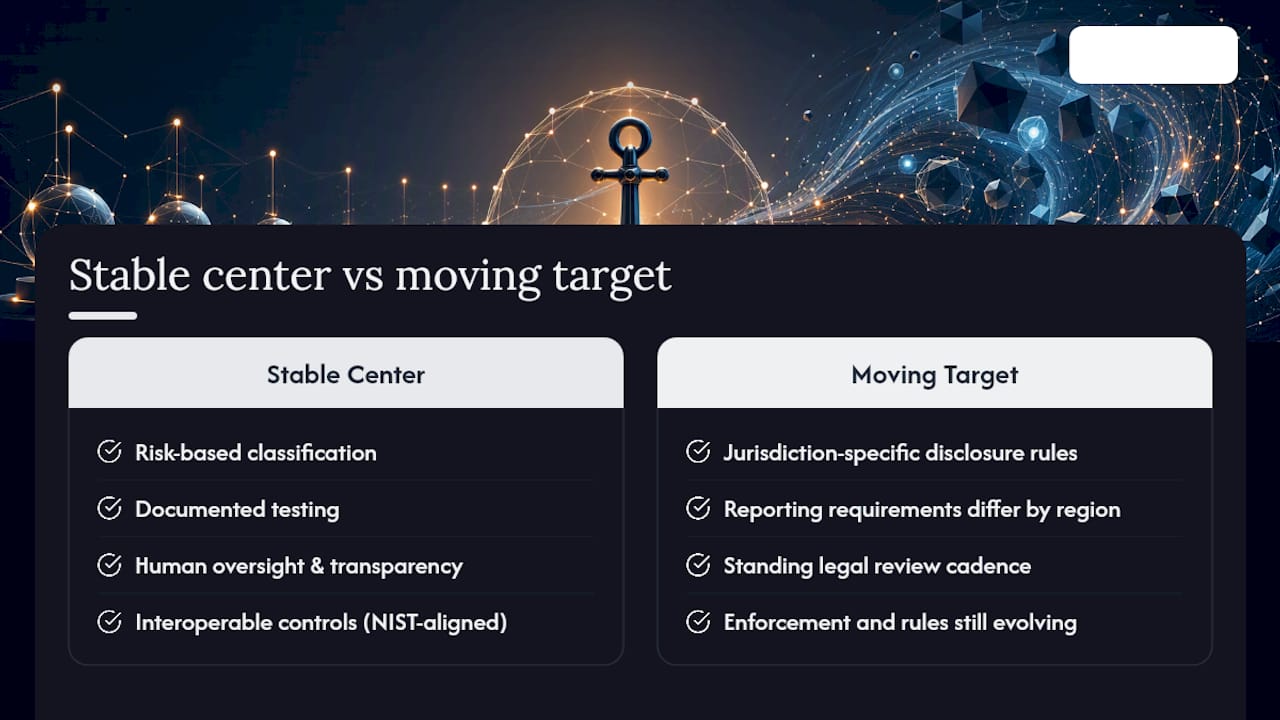
Treat compliance as a moving target with a stable center. The center is risk-based classification and documented testing. The moving part is which specific disclosure or reporting requirement applies in which jurisdiction, and that's worth a standing legal review cadence rather than a one-time check.
Getting Buy-In Across the Organization
A governance framework that lives only in the risk or legal department dies the first time a product team feels it's slowing them down. Stakeholder engagement is what keeps governance alive past the launch of the policy document.
Start by identifying who actually touches generative AI decisions day to day: product managers picking vendors, engineers integrating APIs, marketing teams generating content, customer-facing staff handling escalations. Each group needs a different entry point into the governance conversation, not a single all-hands training that nobody remembers by Friday.
Practical tactics that tend to work:
- Put a product or engineering representative on the AI governance review board, not just legal and compliance staff.
- Frame policy requirements around real incidents or near-misses the team has already seen, not hypothetical scenarios.
- Give teams a fast-track approval path for low-risk use cases so governance doesn't become synonymous with delay.
- Publish a short rationale alongside every new policy rule explaining the specific risk it addresses.
Culture fit matters as much as the policy text. A financial services firm with a conservative risk appetite will write stricter human-oversight rules than a media company experimenting with content generation, and both can be correctly aligned with NIST's functions while landing on very different operational rules. The goal isn't uniformity across every organization. It's consistency between what a company says it values and what its AI policy actually permits.
Folding Generative AI Into Existing Risk and Security Programs
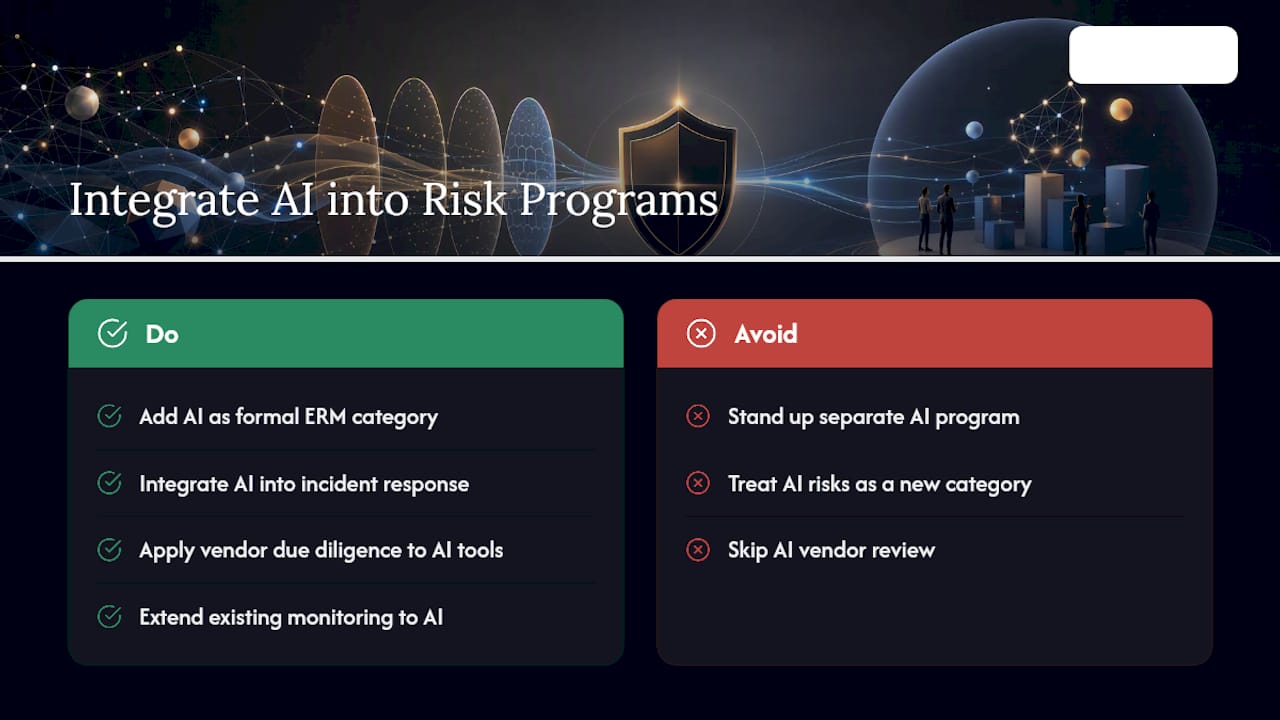
Building a separate governance program for generative AI, disconnected from your existing enterprise risk management (ERM) and cybersecurity functions, creates duplicate work and blind spots. AI risk isn't a new category floating outside your risk register; it's a new source of familiar risks: data leakage, third-party vendor exposure, reputational damage, regulatory noncompliance.
The practical move is to add generative AI as a formal risk category inside whatever ERM structure already exists, whether that's a COSO-aligned framework or an internal risk committee process, rather than standing up a parallel structure. The same applies to cybersecurity: prompt injection and data exfiltration through a chatbot are security incidents, and they belong in the same incident response playbook your security team already runs, not a separate AI-only process that security staff have never seen.
Vendor risk management is where the overlap is most obvious and most often missed. Every third-party generative AI tool is also a third-party vendor, and it should go through the same due diligence, data handling review, and contract language scrutiny your procurement and security teams already apply to any SaaS vendor. If your organization already has a vendor risk questionnaire, add AI-specific questions to it: where is training data sourced, how is output monitored, what's the incident notification timeline.
Automation tools that already support inventory tracking and continuous monitoring in broader risk programs, as outlined in recent guidance on automated risk management, extend naturally to AI-specific monitoring once the risk categories are defined. You're not reinventing your risk infrastructure. You're extending it.
Training Staff Who Actually Use These Tools
Most generative AI incidents inside organizations don't come from sophisticated attacks. They come from an employee pasting sensitive customer data into a public chatbot, or a marketing writer publishing AI-generated copy without checking it for factual accuracy. Training closes that gap, but only if it's ongoing rather than a single onboarding module nobody remembers three months later.
Effective programs run on three tracks. General staff need a short, recurring briefing on what data never goes into a public AI tool and how to spot an obviously fabricated output. Teams actively building on generative AI, engineers, data scientists, product managers, need deeper training on red-teaming basics, prompt injection risks, and how to document TEVV results. Leadership needs enough fluency to ask the right questions during risk reviews, not necessarily to run the tests themselves.
The cadence matters more than the content. A single annual training satisfies a compliance checkbox but does little to change behavior. Quarterly refreshers tied to actual incidents, even minor near-misses, tend to stick because they're concrete rather than theoretical. Pairing training with the acceptable-use policy from your governance baseline reinforces both at once instead of treating them as separate initiatives.
The Transparency Problem Nobody Fully Solves
Explaining how a generative AI model reached a specific output is genuinely hard, and organizations that promise full explainability are usually overstating what's possible. Large language models don't produce a clean decision trail the way a rules-based system does. That reality doesn't excuse organizations from transparency obligations. It just means transparency has to be built differently.
The practical answer is provenance tracking rather than full model explainability: log which data sources fed a RAG system, which model version generated an output, and when a human reviewed or approved it. That gives you an audit trail even when you can't fully explain the model's internal reasoning. Label AI-generated content clearly for both internal reviewers and, where relevant, external audiences, an approach echoed in guidance on labeling AI-generated content for SEO and trust purposes.
The tension worth naming directly: organizations often want to protect proprietary model details while still satisfying disclosure expectations from regulators or customers. The workable middle ground is aggregated reporting, disclosing risk categories, testing methodologies, and incident counts, without exposing trade secrets like exact model architecture or training data specifics. Full transparency and full confidentiality can't coexist. Structured, partial transparency usually can.
Tracking Whether Governance Is Actually Working
A governance program that never gets measured tends to calcify into paperwork. The right metrics tell you whether the controls are catching real problems, not just whether the policy document exists.
Useful KPIs cluster into a few categories. Coverage metrics track what percentage of generative AI use cases are formally inventoried and risk-classified, aiming for as close to complete as the organization can realistically sustain. Testing metrics track how many high-risk systems have current TEVV results and red-team reports on file, and how long it takes to remediate a finding once testing surfaces one. Incident metrics track time to detection, time to containment, and whether incident volume is trending down as controls mature, rather than staying flat or climbing.
Adoption metrics matter too, even though they get less attention. Track how many teams are using the fast-track approval path for low-risk use cases versus routing everything through full review, since a bottleneck there often means the classification rules need adjusting, not that people are ignoring the process.
Review these metrics on the same quarterly cadence recommended for high-risk system testing, and report them to whatever leadership body owns AI risk oversight. A governance program with no metrics reporting to leadership is, in practice, a governance program leadership doesn't actually see.
The Regulatory Direction Is Already Clear Enough to Act On
Waiting for perfect regulatory clarity before building governance is a mistake regulators are actively punishing. The direction of travel, risk-based classification, mandatory testing, incident disclosure, is consistent across the EU AI Act and the frameworks influenced by it, and enforcement capacity is only going to grow from here, as Stanford's policy analysis on generative AI governance makes clear.
Expect testing budgets to grow, red-team engagements to become routine rather than occasional, and dedicated AI risk or compliance hires to become standard at mid-size organizations within the next few years. If budget is tight, prioritize inventory and classification first. Everything else, testing depth, monitoring sophistication, formal training programs, scales more easily once you know what you're actually governing.
— YS
Building These Controls Without Building a New Department
Most organizations don't need a standalone AI governance team to do this well. They need the inventory, testing, and monitoring work built into the systems they're already developing, which is closer to an engineering and integration problem than a policy-writing one.

Yslootahtech works on the implementation side of this exact roadmap: embedding provenance logging, human oversight checkpoints, and monitoring hooks directly into the applications a client is building, rather than handing over a policy document and leaving the technical work to someone else. Through AI and machine learning engagements, generative AI features get built with TEVV logging and escalation paths from day one instead of retrofitted after an incident. Through IT consulting, a governance audit maps your current AI inventory against NIST's four functions and flags the gaps that matter most before a regulator or a customer finds them first. If your organization is somewhere between "we have generative AI tools in use" and "we have a governance program that actually works," the practical next step is a scoped governance audit rather than another internal task force. Reach out through Yslootahtech to scope one.
Sources
- AI Risk Management Framework (AI RMF) — Core functions
- Artificial Intelligence Risk Management Framework: Generative Artificial Intelligence Profile
- EU AI Act (Regulation) — legislative text
- Regulating Under Uncertainty: Governance Options for Generative AI — Stanford FSI
FAQ
What Are the Four Pillars of AI Governance?
The NIST AI RMF defines them as Govern, Map, Measure, and Manage. Govern sets accountability and policy, Map builds the inventory and risk classification, Measure runs testing and evaluation, and Manage handles monitoring and incident response, with Govern threaded through all three others.
What Are the Four Types of Generative AI?
Generative AI is commonly grouped by output type: text generation (chatbots, writing assistants), image generation, code generation, and audio or video generation. Each type carries different governance priorities, text tools raise hallucination and provenance risks, while image and video tools raise deepfake and IP concerns.
Can You Give an Example of AI Governance in Practice?
A retail company deploying a customer support chatbot classifies it as limited risk, sets a policy restricting it from giving legal or financial advice, runs red-team testing before launch, and builds an escalation path to a human agent when the bot's confidence drops. That sequence mirrors the risk classification approach in the EU AI Act.
What Is an AI Governance System?
An AI governance system is the combined set of policies, roles, technical controls, and monitoring processes an organization uses to manage AI risk across its lifecycle. It typically includes an inventory of AI systems, an acceptable-use policy, predeployment testing procedures, and an incident reporting process.
How Do I Start Governing Generative AI If We Have Nothing in Place?
Start with an inventory: list every generative AI tool in use, who uses it, and what data it touches, then assign each one a risk tier. From there, build a short acceptable-use policy and set testing requirements for anything classified as high risk before it goes further into production.