Preserve Rankings in a 2026 B2B Website Redesign With Editable Templates

Run a conversion and SEO audit before anyone opens a design tool, then rebuild with a phased rollout that protects rankings and lead flow. That single sequencing decision determines whether a B2B website redesign grows pipeline or quietly breaks it. Expect three outcomes from doing it right: stable organic traffic through launch, an unbroken lead pipeline, and a measurable lift in demo or trial conversions. Assign an owner to run the audit this week.
TL;DR:
- Conduct a comprehensive SEO and conversion audit before redesigning to identify active pages, ranking performance, and critical form fields, ensuring data integrity.
- Define clear, measurable page-level goals aligned with buyer behavior, focusing on demo bookings, content downloads, or lead forms, and track key KPIs over time.
- Plan a phased rollout starting with high-impact pages to detect and fix issues early, rather than launching everything simultaneously to minimize traffic and lead disruptions.
- Build a detailed redirect map, test lead routing, and verify analytics and form functioning before and during the launch to prevent attribution loss and pipeline drops.
- Consider replatforming only when your current CMS significantly hampers speed, integrations, or content updates, as incremental improvements usually cost less and pose fewer risks.
Table of Contents
- Why Most B2B Website Redesigns Fail
- What Should You Audit Before Redesigning a B2B Site?
- What Business Goals Should Drive the Redesign Brief?
- How Do You Plan the Sitemap and Content Before Design?
- How Do You Design a B2B Site That Actually Converts?
- Should You Replatform or Redesign on Your Current Stack?
- What Does an SEO Migration Checklist Look Like?
- How Do You Protect Lead Data During Development?
- How Should You Sequence Testing and Launch?
- What Should You Measure After Launch?
- How Does a B2B Vendor Actually Scope a Redesign?
- When Should You Hire a Partner Instead of Building In-House?
- Redesigns Fail on Sequencing, Not Talent
- How Yslootahtech Approaches Your Redesign
- Sources
- FAQ
Why Most B2B Website Redesigns Fail
Most redesigns don't fail because of bad visual design. They fail because of sequencing. Teams jump to wireframes and brand colors before anyone checks what the current site actually does for the business, and that gap shows up six months later as a traffic cliff or a lead form that silently drops half its submissions.
The recurring failure patterns look like this:
- Design-first thinking. Stakeholders approve a homepage mockup before anyone defines what a "conversion" even means for each page type.
- Skipped audits. No one inventories which URLs rank, which pages actually generate pipeline, or which forms feed the CRM correctly.
- SEO migration mistakes. Redirects get built as an afterthought, or worse, built by the developer from memory instead of a tested map.
- Broken form-to-CRM plumbing. Hidden UTM fields, lead scoring rules, and routing logic get rebuilt incorrectly, so marketing loses attribution the week the site goes live.
- Big-bang launches. The entire site flips overnight with no way to isolate which change caused a conversion drop.
Agency reviews of failed B2B redesigns consistently point to the same three fracture points: SEO migration, form-to-CRM plumbing, and live campaign pages. If your project plan doesn't name an owner for each of those three, the plan is incomplete regardless of how polished the mockups look.
Run this self-check now: Do you have a URL-level redirect map? Has someone tested a lead end-to-end through the new forms? Are your top five paid landing pages excluded from the redesign until replacements are validated? If any answer is no, stop and fix the plan before development starts.
What Should You Audit Before Redesigning a B2B Site?
Audit the site the way a buyer or a search engine actually experiences it, not the way your team remembers building it. The audit output becomes your project brief. Skip it, and you're redesigning based on opinion instead of evidence.
Here's the sequence that works:
- Pull a full URL inventory. Cross-reference Google Search Console data with a crawler like Screaming Frog to see which pages actually earn organic clicks and impressions. Sort by traffic and by the queries driving it.
- Export analytics and CRM data. Map which pages influence pipeline, not just which get traffic. A blog post with high volume but zero assisted conversions matters less than a mid-funnel comparison page that quietly closes deals.
- Inventory active paid campaign landers. These pages often live outside the main navigation and get forgotten. Preserve them exactly as-is until their replacements have proven performance, since a paused campaign still burns budget on a broken page.
- Map every form field, including hidden ones. UTM parameters, lead source values, and campaign IDs frequently live in hidden fields that a redesign can wipe out without anyone noticing until the pipeline report looks strange three weeks later.
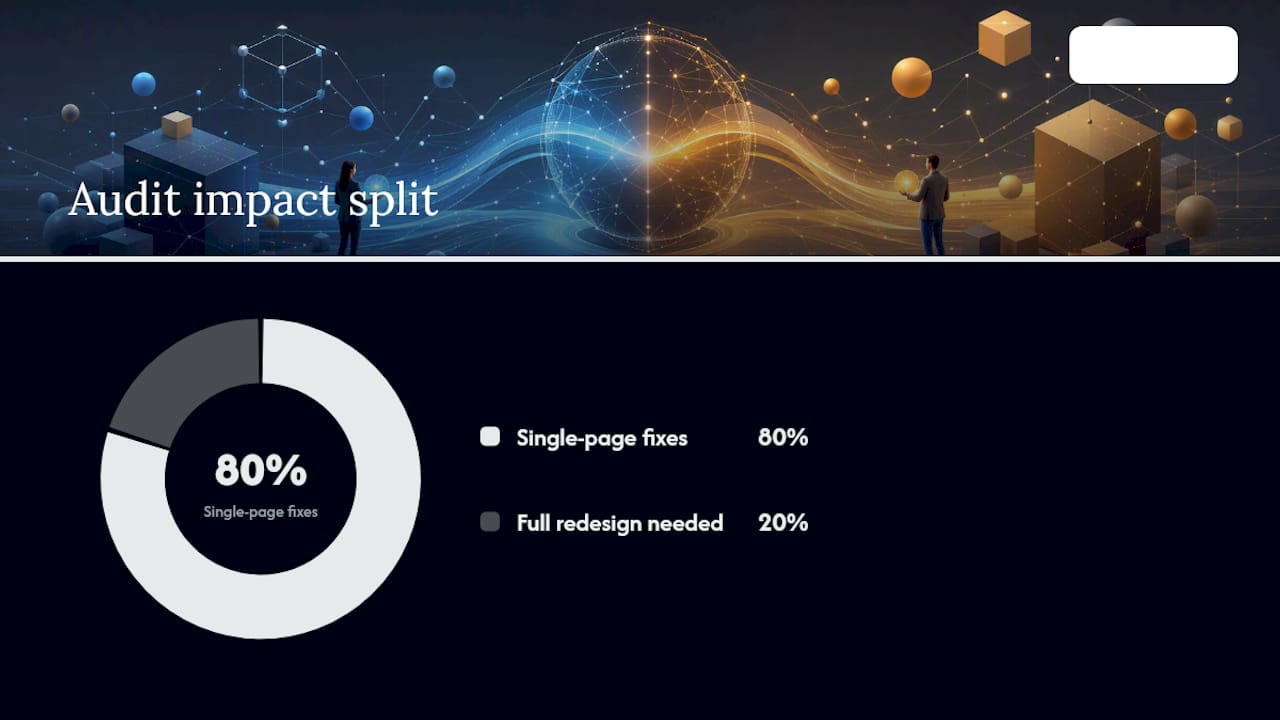
A 1-2 week conversion audit frequently surfaces single-page fixes that solve 80% of the problem without touching the rest of the site. That's worth knowing before you commit budget to a full rebuild.
Pro Tip: Run a test lead through every form on the current site before you touch anything, and screenshot the CRM record it creates. That screenshot becomes your acceptance test for the new site's forms.
What Business Goals Should Drive the Redesign Brief?
Every page needs one primary conversion, defined in writing, before a wireframe gets drawn. "Improve the user experience" is not a goal a designer can build against.
Write page-level goals that match how buyers actually behave:
- Product and pricing pages: demo booking or trial signup as the primary action.
- Resource and blog content: newsletter signup or content download as a soft conversion, with demo booking as a secondary path.
- Contact and about pages: qualified lead form completion, not just a generic "contact us" submission.
Track KPIs in three windows: before launch (your baseline), during rollout (watch for drops), and 90 days after (the real verdict). The metrics that matter most are demo booking rate, qualified lead rate, and organic traffic stability, since Gartner's 2026 sales research found 67% of B2B buyers now prefer evaluating vendors without talking to a sales rep first.
That preference changes what a good B2B site has to do. Map your buyer personas (technical evaluator, economic buyer, end user) against the pages each one actually visits, and prioritize self-serve proof (case studies, pricing clarity, security documentation) over gated content that assumes a rep will fill in the gaps.
How Do You Plan the Sitemap and Content Before Design?
Information architecture decisions made before any visual design work will save more budget than any other single choice in the project. Every page falls into one of four buckets: keep, merge, retire, or rewrite. Traffic and conversion data from the audit tells you which bucket each page belongs in, not gut instinct.
- Keep as-is: pages ranking well and converting well. Touch these last and carefully.
- Merge: thin or overlapping pages competing for the same keyword. Combining three mediocre pages into one strong one usually outperforms all three separately.
- Retire: pages with no traffic, no conversions, and no strategic reason to exist. Redirect them to the closest relevant page.
- Rewrite: pages with strong intent-match but weak execution, like outdated product pages still ranking despite thin content.
Count your unique templates before development quotes come in, since template count, not page count, is the real cost driver. A 200-page site built on 12 templates is a fraction of the engineering cost of a 200-page site with 40 unique layouts.
Ship in priority order: top-ranking organic pages first, then product and pricing, then active campaign landers, then everything else.
How Do You Design a B2B Site That Actually Converts?
Wireframes need sign-off before anyone opens a design tool. This isn't bureaucracy. It locks the conversion architecture (where the CTA sits, what proof appears near it, what the page's single job is) before visual polish makes changes expensive. Practitioner guidance consistently finds that skipping wireframe approval causes the most expensive late-stage rework in B2B redesigns.
Once architecture is locked, these design rules move the conversion needle:
- State the value proposition in one sentence, above the fold. If a visitor can't tell what you do in five seconds, the rest of the page doesn't matter.
- Give the primary CTA visual contrast, not just a different color from the background, but genuine separation from every other clickable element on the page.
- Place proof near the CTA, not in a separate testimonials page. A client logo or a specific result next to the "Book a Demo" button does more work than the same logo three scrolls away.
- Write for scanning. B2B buyers skim. Subheads, bold key phrases, and short paragraphs outperform dense blocks every time.
Accessibility isn't optional polish. Build to WCAG 2.1 AA as the baseline, because color contrast, keyboard navigation, and screen reader compatibility affect real buyers and increasingly show up in procurement requirements for enterprise deals.
Pro Tip: Test your hero section on a phone before anything else. Most B2B decision-makers first encounter your site on a phone during a commute or between meetings, not at a desktop reviewing a competitive shortlist.
Should You Replatform or Redesign on Your Current Stack?
Replatforming makes sense when your current system is the actual bottleneck, not just an inconvenience. Weigh these factors before deciding:
- Marketing editability. Can non-technical staff publish a landing page without filing an engineering ticket?
- Page velocity. How long does it take today to ship a new campaign page, start to finish?
- Integrations. Does the platform connect cleanly to your CRM and marketing automation stack, or does every integration require custom code?
- Core Web Vitals and security. Is the current stack holding back page speed or exposing outdated dependencies?
- Total cost. Licensing plus engineering hours plus opportunity cost of slow publishing.
Marketing teams increasingly favor marketing-editable platforms like Webflow specifically to cut the engineering backlog on routine page updates. That trade-off is real: more marketing autonomy, less deep engineering control, and for most B2B teams running frequent campaigns, that trade pays off.
Replatforming is justified when you're rebuilding the design system anyway, when integrations are fundamentally broken, or when publishing velocity is actively costing you campaign performance. It's not justified as a reaction to a stale color scheme. If the architecture and content still perform, an incremental refresh usually costs less and disrupts nothing.
What Does an SEO Migration Checklist Look Like?
SEO migration is where redesigns lose the most organic traffic, and it's almost always preventable with a checklist, not talent. Agency reviews found SEO migration failures rank among the top three causes of B2B redesign pipeline damage.
Work through this sequence before launch, not after:
- Build a 1:1 redirect map covering every URL that's changing, and test it on staging before it ever touches production. Use 301 redirects, not 302s, for anything permanent.
- Preserve content parity on ranking pages. If a page currently ranks for a valuable term, the new version needs equal or better depth on that topic, not a shorter "cleaner" rewrite that drops the content actually earning the ranking.
- Update metadata systematically, title tags and meta descriptions across every template, rather than leaving default CMS placeholders live at launch.
- Retain internal linking patterns where they support ranking pages. A page losing internal links overnight can lose ranking signal even with a perfect redirect.
- Monitor Search Console and rank tracking daily for the first two weeks, and define a rollback trigger in advance, such as a 20% drop in indexed pages or a sustained ranking loss on a top-10 keyword.
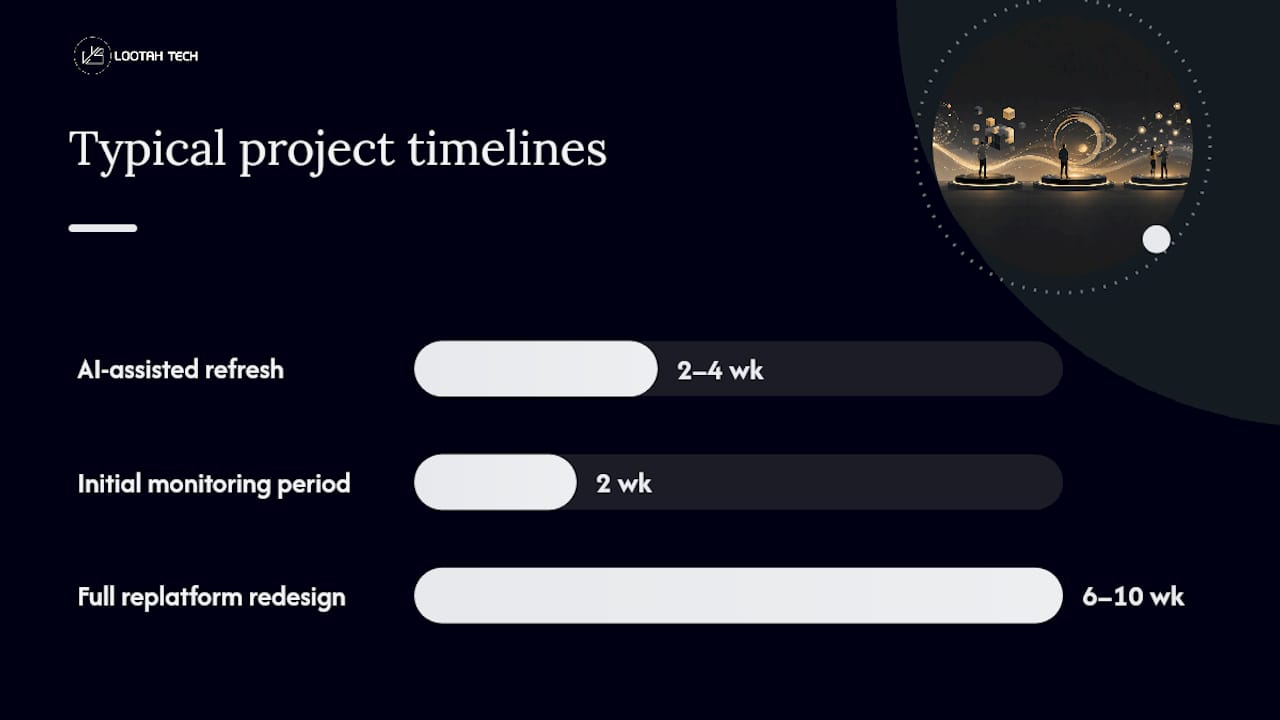
Timelines vary by scope. Practitioner estimates put an AI-assisted marketing-site refresh at two to four weeks, while a full replatform with a new design system typically runs six to ten weeks. Keeping AI-assisted content production in sync with your SEO priorities during that window, using tools built for content and on-page SEO cadence, helps close the gap between launch and full content parity.
How Do You Protect Lead Data During Development?
Every form needs a field mapping matrix before development starts, listing each field, its CRM destination, and whether it's visible or hidden. Hidden fields carrying UTM parameters, campaign IDs, and lead source values are the ones that silently break, since no one notices a missing attribution field until a monthly pipeline report shows a mysterious drop in a channel that didn't actually stop working.
Build these safeguards into the development plan:
- Write an end-to-end test script that submits a real test lead through every form, then confirms it lands correctly in the CRM with proper enrichment and routing to the right sales rep or queue.
- Audit every third-party script, tag manager container, chat widget, and analytics pixel, and rebuild the consent and cookie handling to match current requirements rather than copying old code blindly.
- Migrate analytics events deliberately. Goal completions, event tracking, and conversion pixels need to be rebuilt and verified, not assumed to carry over automatically.
- Test lead routing logic specifically, since a lead that reaches the CRM but routes to the wrong rep or skips scoring entirely is functionally the same as a lost lead. Reviewing how lead generation flows actually work end-to-end helps catch these gaps before launch, not after.
How Should You Sequence Testing and Launch?
Phased, page-by-page rollout beats a single big-bang launch for nearly every B2B redesign. Case studies of successful migrations show that shipping highest-impact pages first while monitoring metrics continuously catches problems while they're still cheap to fix. Ship your top organic landing pages and highest-traffic product pages early, since those carry the most risk and the most signal.
Before any page goes live, run through this checklist:
- Cross-browser and cross-device testing, including the specific mobile devices your analytics show visitors actually use.
- Full form testing on every variant, not just the primary contact form.
- Page speed budgets checked against Core Web Vitals thresholds before launch, not after a ranking drop forces the issue.
- Analytics and conversion tracking verified live on staging, with real test conversions confirmed in the reporting dashboard.
After each page goes live, hold a verification window of 48 to 72 hours with daily monitoring before shipping the next batch. In the first 90 days, prioritize A/B tests on hero headlines, CTA placement, and proof element positioning, since those three elements consistently move conversion rates the most in early testing rounds.
Pro Tip: Keep the old page live at a staging URL for at least 30 days post-launch. When a stakeholder asks "why did we change this," you'll want the side-by-side comparison ready instead of relying on memory.
What Should You Measure After Launch?
Demo booking rate, qualified lead rate, and organic session stability are the three metrics that tell you whether the redesign worked, and none of them are visible on launch day. Give the site 60 to 90 days before drawing conclusions, since search engines need time to fully re-crawl and re-rank, and buyer behavior takes a few weeks to normalize after a visual change.
Run experiments in a deliberate order rather than testing everything at once:
- Hero headline variations first, since they affect every visitor and typically produce the clearest signal fastest.
- CTA placement and copy second, testing button text against action-oriented alternatives.
- Proof and social proof variations third, testing which client logos or specific results actually move the needle for your buyers.
HubSpot's research on prospecting touchpoints reinforces a pattern worth building into your roadmap: buyers rarely convert on a single visit, so post-launch optimization should also track multi-touch paths, not just last-click conversions on the demo page.
Build a standing feedback loop with sales. A five-minute monthly conversation about which leads convert and which ones stall gives you better test ideas than another round of internal design opinions. Track outcomes against the broader digital strategy framework guiding the redesign so post-launch tests stay tied to actual business goals, not vanity metrics.
How Does a B2B Vendor Actually Scope a Redesign?
A properly scoped redesign starts with the same audit outputs covered above: URL inventory, conversion data by page, active campaign landers, and a form-to-CRM field map. Vendors experienced in B2B work treat those outputs as the actual project brief, not a formality to skip on the way to wireframes.
Yslootahtech approaches redesign scoping through website development, UX/UI design, and systems integration together rather than as separate disconnected phases, since a redesign that nails the visual design but breaks CRM routing is not a success by any real measure. A workable scoping checklist looks like this: audit outputs documented and reviewed with stakeholders, a template count locked before development quotes, a redirect map tested on staging, and a phasing plan that ships high-value pages first.
Deliverables at each phase should be concrete. Wireframes with sign-off, a design system with documented components, a tested staging environment, and a post-launch monitoring plan with named rollback triggers. Vague deliverables like "improved user experience" or "modern design" belong nowhere in a scope of work, because neither one is measurable against the KPIs defined in the project brief.
When Should You Hire a Partner Instead of Building In-House?
Weigh time, skills, risk, and budget honestly before deciding. If your team has never executed an SEO migration with redirect mapping and content parity, that's a specific skill gap, not a general capability question, and it's usually cheaper to bring in expertise than to learn it through a botched launch. If internal bandwidth is already stretched across other priorities, a redesign competing for attention tends to lose, badly, at the worst possible moment.
If you go the RFP route, insist on three things in every proposal: a documented redirect map methodology, a written end-to-end test plan covering forms and analytics, and a defined SLA for post-launch fixes. A proposal missing any of those three is missing the parts of the project that actually determine whether pipeline survives the transition.
Redesigns Fail on Sequencing, Not Talent
Here's what the industry keeps getting backwards: teams treat design quality as the variable that determines redesign success, when sequencing is the actual variable. A mediocre visual design shipped in the right order, audit first, conversion goals defined, phased rollout, beats a beautiful design shipped as a big-bang launch nearly every time. The data on migration failures backs this up consistently: the damage comes from process gaps, not aesthetic ones.
The overlooked nuance is this: most B2B marketing leaders underestimate how much of their organic traffic depends on content and structure that predates the current team, and a "clean slate" redesign instinct actively threatens that inherited equity. The conversion audit isn't a formality before the fun part starts. It's the part of the project that decides whether the fun part is even worth doing at full scope, or whether three targeted page fixes would deliver the same lift at a fraction of the cost and risk.
The other place conventional wisdom gets it wrong is speed. Marketing leaders under pressure to "modernize" often push for a single launch date because it feels decisive. It's the opposite of decisive. A phased rollout gives you the ability to catch a broken form or a ranking drop on one page before it becomes a site-wide problem, and that optionality is worth more than the psychological comfort of a single go-live moment.
— YS
How Yslootahtech Approaches Your Redesign
If you're comparing a full agency retainer against a scrappy freelance rebuild, there's a third path worth weighing: a single partner who scopes the audit, designs the conversion architecture, builds the integrations, and stays on for post-launch fixes, without handing you off between three different vendors mid-project.

Yslootahtech maps its services directly to each redesign phase covered above. The audit and strategy work feeds into UX and UI design for wireframes and visual systems, then into website development for the build itself, with application development support when a redesign needs custom CRM connectors or form logic beyond standard CMS capabilities. For teams still deciding whether the current design serves the conversion goals defined earlier, UX/UI design work starts with the same wireframe sign-off process this article recommends, not a jump straight to visual polish.
An initial discovery call covers your current site's audit status, your priority KPIs, and a rough scope: template count, integration complexity, and timeline. Book a discovery call through the website development page to start that scoping conversation.
Sources
- Gartner press release: 67% prefer rep-free experience
- HubSpot: The ultimate guide to prospecting (touchpoints)
FAQ
What Will B2B Selling Look Like in 2026?
B2B selling in 2026 leans heavily toward self-serve evaluation, with 67% of buyers preferring a rep-free experience, which means your website needs to answer the questions a sales rep used to handle in a first call.
What Is the Rule of 7 in B2B?
The rule of 7 is a marketing principle suggesting buyers need multiple touchpoints with a brand before converting, and current HubSpot guidance on prospecting frames this as a reason to design multiple conversion paths across your site, not a single homepage CTA.
How Do I Build a B2B Website?
Start with a conversion and SEO audit, define page-level KPIs, plan the sitemap around traffic and intent data, build wireframes before visual design, and launch in phases with a tested redirect map, rather than starting with visual design or a full site rebuild.
What Is the Top B2B Website in the UAE?
There's no single verified ranking for "top B2B website" in the UAE, since B2B site performance depends on industry, target buyer, and specific KPIs rather than one universal standard. Evaluate any UAE-based B2B site against its own conversion data, organic visibility, and lead quality, not a general reputation claim.
How Long Does a B2B Website Redesign Take?
Timelines depend on scope. A marketing-template refresh typically takes two to four weeks, while a full replatform with a new design system usually runs six to ten weeks.