90–180 Day API Integration Strategy for Enterprise Leaders

Adopt an API-first, governed API-led architecture. Treat every API as a product with an owner, a contract, and a lifecycle, and enforce a lightweight baseline through automated checks rather than manual review boards. Enterprises that follow this path get reusable integrations, faster delivery cycles, and materially lower operational risk than teams stitching together point-to-point connections. The rest of this guide walks through the governance model, the architecture layers, and a 90 to 180 day rollout plan you can hand to your team this quarter.
TL;DR:
- Following an API-first, governed architecture reduces operational risk and accelerates delivery by enforcing reusable, well-designed APIs with clear ownership and lifecycle management.
- Implementing strict discoverability, reusability, versioning discipline, and consumer-first design prevents API sprawl and fragility over time.
- A layered architecture with system, process, and experience APIs, combined with appropriate security controls and automation tools, supports scalable and secure integrations.
- Rolling out an API strategy in 90 days is feasible by focusing on inventory, contract development, pilot deployment, and scaling, with emphasis on quick, measurable successes.
- Balancing central governance with domain team autonomy ensures rapid delivery without sacrificing control, while wrapping third-party APIs behind internal layers simplifies management and upgrades.
Table of Contents
- What Is an API Integration Strategy?
- Setting Up API Governance and Lifecycle Management
- Which Architecture Pattern Fits Your Integration Layer?
- What Security Controls Does Every API Need?
- What Tools Automate API Management Best Practices?
- How Do You Roll Out an API Integration Plan in 90 Days?
- What Trade-Offs Actually Show Up in API Projects?
- How Should You Approach Third-Party API Integration?
- How Do Companies Monetize APIs?
- When Should You Go API-First Versus Use Tactical Adapters?
- Build Your API Integration Strategy With YS Lootah Tech
- Sources
- FAQ
What Is an API Integration Strategy?
An API integration strategy is the set of decisions that determine how your systems expose data and functionality to each other, to partners, and to your own product teams, and how you keep that exposure consistent as the number of APIs grows. The strategy fails the moment teams start building direct, one-off connections between systems because a new integration always breaks something two versions later.
The fix is treating APIs as products rather than plumbing. API-first design means writing the contract before writing the implementation, which lets frontend and backend teams build in parallel instead of waiting on each other. A workable API integration strategy rests on four principles:
- Discoverability — teams can find and understand an API without asking its owner
- Reusability — one well-designed API replaces five one-off integrations
- Versioning discipline — breaking changes get a new version, not a silent update
- Consumer-first design — the API is shaped around what callers need, not around your internal database schema
Skip any one of these and you get an API sprawl problem within eighteen months.
Setting Up API Governance and Lifecycle Management
Governance sounds bureaucratic until you have 200 APIs and nobody can say which ones are still in use. The discipline that prevents that mess has three legs: an inventory, a classification scheme, and a baseline of rules everyone follows without needing a meeting.
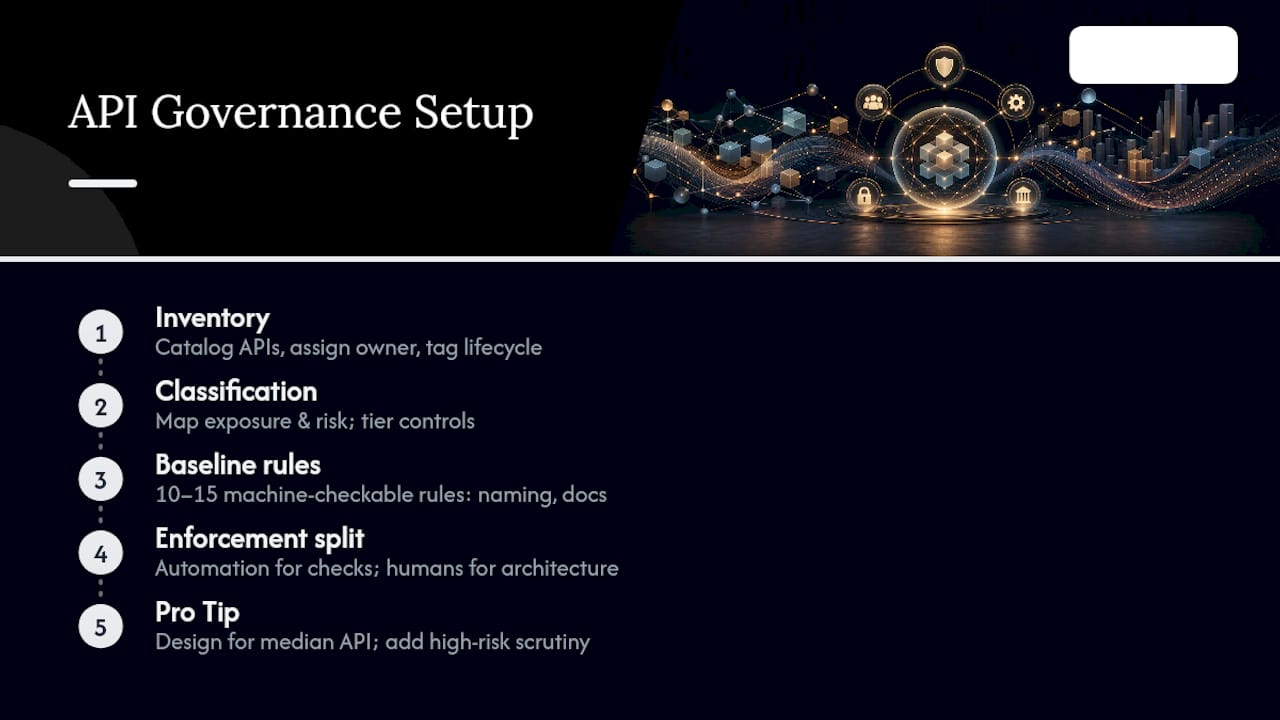
1. Build the inventory first. Catalog every API, assign an owner, and tag its lifecycle state (design, active, deprecated, retired). You cannot govern what you cannot see, and API governance only works once that source of truth exists.
2. Classify by exposure and risk. A public partner-facing payments API needs stricter controls than an internal reporting endpoint two teams use. Map controls to risk tier instead of applying one heavy process to everything.
3. Write down a minimum baseline. Naming conventions, standard error codes, mandatory documentation fields, and a versioning policy. Effective programs start with a small set of machine-checkable rules, often 10 to 15, enforced through linters before anything more elaborate gets added.
4. Split enforcement between automation and people. Automated checks catch naming and schema violations in seconds. Manual review stays reserved for architecture decisions that a linter cannot judge, like whether an API should exist at all.
Pro Tip: Don't design your governance baseline around your worst API. Design it around your median API, then add extra scrutiny for the high-risk tier only.
Which Architecture Pattern Fits Your Integration Layer?
Most integration failures trace back to putting logic in the wrong layer. The API-led model splits work into three tiers, and knowing which tier owns which job stops the tangle before it starts.
- System APIs sit closest to the source of record (an ERP, a core banking platform, a legacy database) and expose that data in a stable, generic form.
- Process APIs combine and orchestrate multiple system APIs into a business capability, like "calculate shipping cost" or "check credit eligibility."
- Experience APIs shape data for a specific channel, whether that is a mobile app, a partner portal, or a voice assistant.
Request/response APIs work well when a caller needs an immediate answer. Event-driven patterns fit better when something happens once and many systems need to react, such as an order status change fanning out to inventory, billing, and notifications simultaneously. Most enterprise estates need both, not one or the other.
The gateway sits at the edge of this whole structure, handling authentication, rate limiting, and traffic shaping. Business logic, data transformation, and orchestration belong inside the process and experience layers, never bolted onto the gateway as a workaround. Teams building on major SaaS platforms often see this pattern play out directly in how they structure Salesforce integration architecture.
What Security Controls Does Every API Need?
Security failures in API programs rarely come from exotic attacks. They come from skipped basics applied inconsistently across a growing API count. A few controls belong on every API regardless of classification, and a few scale up with risk tier.
- Authentication and authorization: OAuth 2.0 for most consumer and partner scenarios, mutual TLS for service-to-service traffic where certificate-based trust matters more than token flexibility.
- Rate limiting and input validation at the gateway layer, so a misbehaving consumer cannot take down a shared backend.
- Secrets management through a dedicated vault rather than environment variables checked into a config file.
- Environment separation so a compromised sandbox credential cannot touch production data.
- Logging with defined retention, aligned to your privacy obligations, feeding back into gateway metrics as evidence for audits and deprecation decisions.
Gateways like Apache APISIX give you enforcement primitives, authentication, rate limiting, request transformation, and metrics export, but the gateway itself does not replace organizational ownership or a catalog. It enforces policy; it does not decide what the policy should be. Apply controls proportionately: a public partner API gets full logging and strict rate limits, while an internal API between two trusted services can run lighter. For teams also managing cloud workloads, the same proportionality logic applies to cloud security controls more broadly.
What Tools Automate API Management Best Practices?
The tooling stack that makes governance sustainable rather than a document nobody reads has four layers.
- Design time: write the contract in OpenAPI first, run it through a linter like Spectral, and generate a mock server from the spec before a single line of implementation code exists.
- CI/CD: contract tests that fail the build when an API breaks its published schema, plus automated governance checks that flag naming or versioning violations before merge. Automating design checks in CI shifts quality control left, catching problems before they reach production instead of after.
- Catalog and developer portal: a searchable, single source of truth so a team building a new feature checks for an existing API before building a redundant one.
- Observability: gateway metrics, error rates, and consumer-level traffic breakdowns that tell you which deprecated versions still carry live traffic.
Contract-first workflows also pay off in raw developer time: mock servers and generated SDKs let frontend and backend teams build against a stable contract simultaneously instead of waiting on each other. Teams building AI-driven onboarding flows on top of these APIs can find useful patterns in developer-focused AI tooling for docs and onboarding automation.
How Do You Roll Out an API Integration Plan in 90 Days?
A pilot beats a master plan every time, because a master plan takes a year to write and by then your architecture has already changed underneath it.
- Weeks 1 to 2: Inventory and pilot selection. Catalog existing APIs, even the undocumented ones, and pick one business domain with a clear, measurable pain point (a slow partner onboarding flow, a fragile order-to-cash link).
- Weeks 3 to 6: Build the contract. Write the OpenAPI spec, run it through a linter, stand up a mock server, and let consuming teams start integrating against the mock before the real backend exists.
- Weeks 7 to 10: Run the pilot integration. Deploy behind a gateway with rate limiting and authentication in place from day one, not bolted on afterward.
- Weeks 11 to 16: Operationalize. Onboard real consumers, track time-to-first-integration and API reuse rate, and fix what the metrics show is slow.
- Weeks 17 to 26: Scale. Expand the catalog, automate the governance checks that worked manually in the pilot, and enforce a deprecation policy for anything the new pattern replaces.
Pro Tip: Pick a pilot domain where success is easy to measure in weeks, not quarters. A partner onboarding API that used to take three weeks to integrate and now takes three days is a story that funds the next phase of the rollout. For a more detailed enterprise version of this timeline, see the 90-day API-first integration plan.
What Trade-Offs Actually Show Up in API Projects?
The recurring tension in every API program is centralized guardrails versus domain team autonomy. Lock everything down centrally and delivery slows to a crawl. Let every domain team do its own thing and you risk duplicating similar integrations multiple times.
The projects that work best split the difference: a central team owns the baseline, the gateway config, and the catalog, while domain teams own delivery speed within those guardrails. A commerce platform team building checkout APIs moves fast inside rules a fintech team set for authentication. A digital health team building a patient data API inherits stricter logging defaults without negotiating them from scratch each time.
Before hiring outside help or building internally, ask three questions: does this need to exist for years or just this project, does more than one team consume it, and does getting the contract wrong carry compliance risk. The answers tell you how much rigor to apply.
— YS
How Should You Approach Third-Party API Integration?
Third-party APIs introduce a dependency you don't control, and that changes how you should design around them from the start. Wrap every external API behind an internal system API layer rather than letting five different internal services call the third-party endpoint directly. When the vendor changes its pricing tier, deprecates a field, or has an outage, you fix one internal wrapper instead of chasing five call sites.
Contract stability is the real risk with partner APIs, not just uptime. Vendors deprecate versions on their own timeline, sometimes with thirty days' notice, sometimes with more courtesy than that. Track the versions you depend on in your API catalog the same way you track internal APIs, and set up alerts for deprecation notices instead of discovering a break in production.
Rate limits deserve a second look too. A partner API that caps you at 100 requests per minute becomes a hard ceiling on your own feature's performance, so design caching and batching into your integration layer rather than hoping the partner raises your limit later. Build retry logic with backoff for transient failures, and treat a partner's status page as part of your own monitoring stack.
Legal and technical review should happen together, not sequentially. A partnership agreement that grants API access under specific data usage terms needs to be reflected in how your engineers actually configure scopes and logging, not filed away in a separate contract folder nobody on the integration team reads. When a partnership scales past a handful of endpoints, treat it the way you'd treat an internal high-risk API: dedicated monitoring, a named internal owner, and a documented fallback if the partner's service degrades.
How Do Companies Monetize APIs?
APIs stopped being purely internal plumbing years ago. Plenty of enterprises now run APIs as revenue lines in their own right, and the business model you pick shapes almost every technical decision downstream of it.
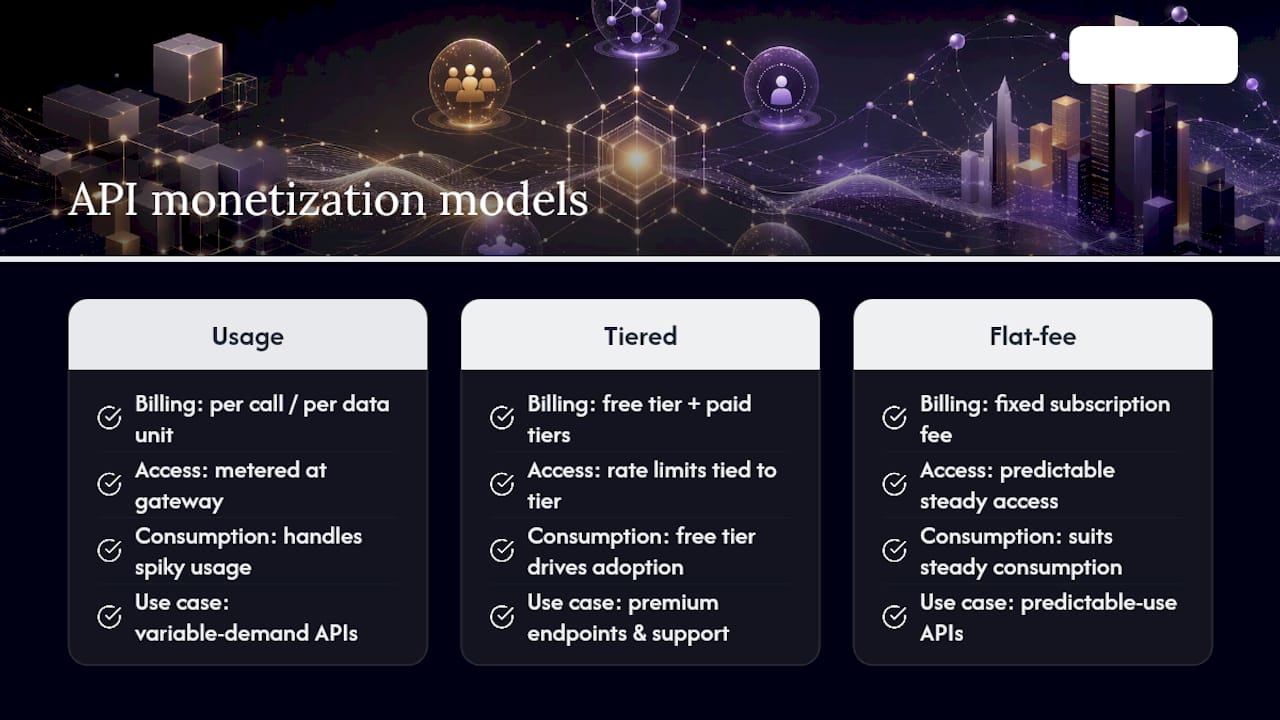
The most common model is usage-based billing: consumers pay per call or per unit of data transferred, which requires accurate metering at the gateway level and a billing system that reconciles against it. Tiered access is the second common pattern, where a free tier drives adoption and paid tiers unlock higher rate limits, premium endpoints, or dedicated support. Flat-fee subscription access works best for APIs with predictable, steady consumption rather than spiky usage.
A fourth model, revenue share, shows up in partner ecosystems where the API enables a transaction and the API provider takes a cut, common in payments and marketplace platforms.
Whichever model you choose, the technical requirements converge on the same list: precise usage metering at the gateway, tiered rate limiting tied to the billing plan, a developer portal that makes signup and key management self-service, and clear documentation that reduces support load. Monetized APIs also demand tighter SLA commitments than internal ones, since a partner's revenue now depends on your uptime. That reality pushes monetized APIs toward the top of your risk classification automatically, with the logging and monitoring rigor that classification demands.
When Should You Go API-First Versus Use Tactical Adapters?
API-first earns its cost when multiple teams will consume the integration, when partners touch it, or when you're building a platform meant to last years. If it's a single point-to-point fix with a six-month shelf life, a tactical adapter or middleware connector is the pragmatic call, not a failure of discipline. Many enterprises run both at once: API-first for the platform core, adapters for the edges, migrated later once volume justifies the investment.
Build Your API Integration Strategy With YS Lootah Tech
A technology partner can provide a direct path to the roadmap outlined above, without spending six months assembling an internal team to figure out contracts, gateways, and governance from scratch. Their engineers can handle IT consulting for strategy and governance setup, application development for the actual APIs and integration platforms, and the architecture decisions that determine whether your system survives its next five integrations.
If you're staring at an API sprawl problem right now, or you're about to start from zero, the fastest way forward is a technical assessment scoped around a single pilot domain, not a year-long transformation program. We'll help you pick the pilot, define the contract, and set up the gateway policies before your team writes a line of implementation code. Start with an IT consulting engagement to scope the assessment, or go straight to application development if you already know which integration needs building first.
Sources
For deeper technical detail beyond this guide, consult Postman's API-first resources, IBM's overview of API governance, and Apache APISIX's documentation on runtime governance. Swagger's writing on contract-first development and Postman's API governance catalog guidance round out the picture for teams building their own baseline.
- What Is API Governance? (API Portal)
- How Apache APISIX Supports Runtime API Governance (APISIX)
- Understanding the API-first approach (Swagger)
FAQ
What Is an API Integration Strategy?
It's the set of decisions and standards that govern how your systems, partners, and product teams connect through APIs, covering design principles, governance, security, and lifecycle management so integrations stay reusable instead of turning into one-off fixes.
What Are the Stages of API Integration?
Most programs move through inventory and assessment, design and contract definition, a pilot build, gateway deployment with security controls, and a scale phase where governance and catalog processes get automated.
What Is API Integration in Simple Terms?
API integration connects two or more systems so they can exchange data or trigger actions automatically, without a person manually moving information between them.
What Are the Main API Methods?
The core HTTP methods are GET (retrieve data), POST (create a resource), PUT (replace a resource), PATCH (partially update a resource), and DELETE (remove a resource).
How Much Does It Cost to Build an API Integration Strategy?
Cost depends on the number of systems involved, the pilot scope, and whether you need new architecture or are extending existing systems. Yslootahtech scopes this through an initial IT consulting engagement rather than a flat published rate, since every enterprise's starting point differs.